
Start a Hamtramck Residents Search
Hamtramck does not have one official roll that answers every question about a resident. The useful starting source depends on whether the known fact is a parcel, a person’s name, a court matter, or a past address. Current property work begins with the city assessor’s public parcel record. A person seeking registration information should use the Michigan voter tool. A deed, court case, certificate, or old directory each belongs to a different custodian and carries a different level of proof.
Keep a short source log as you search. Write down the spelling used, the result date, and the record’s role. An assessor owner line is not the same as an occupant listing. A deed names the parties to a recorded transfer. A directory records an editorial snapshot. This separation avoids turning several partial records into an unsupported claim about one household.
- Search the address or name in Hamtramck BS&A and save the parcel number or location ID.
- Compare the parcel with the city boundary and street context in the GIS viewer.
- Use the legal description or owner name to follow recorded instruments through Wayne County.
- For a historical household, pair a directory entry with the closest public census schedule.
- Use a narrow Michigan FOIA request, a clerk counter, library, archive, or certified-copy route when no public web result exists.
Note: A blank result is a finding about one source and date, not proof that a person has no connection to Hamtramck.
Hamtramck Resident Records Offices
Records for Hamtramck are split between city, county, and state offices. The city assessor maintains the current local assessment layer. Wayne County holds land instruments, county clerk records, and probate routes. Michigan agencies run voter, vital, and statewide court services. The City Clerk is the municipal records custodian for council material, ordinances, election material, licenses, and other city documents. For an address-by-address trail, the Hamtramck street directory keeps the parcel and street steps together.
Wayne Register of Deeds
400 Monroe Street
Detroit, MI 48226
(313) 224-5850
Hamtramck Assessing
3401 Evaline Street
Hamtramck, MI 48212
(313) 800-5233 ext. 820
Michigan Bureau of Elections
Michigan Department of State
Lansing, MI
Michigan Voter Information Center
Hamtramck Parcel Records by Field
The public BS&A landing page accepts an Address, Name, or Parcel Number, and links to a detailed record search. Its services also point to current tax, utility, building, assessing, licensing, permit, and payment areas. The public sample card shows why a parcel search is useful as a first locator: it presents a parcel number, location ID, situs address, owner line, property class, building details, assessed and taxable values, and tabs for property, tax, building, and utility information. It is reference data, so a correction belongs with the municipality.
| BS&A field or control | Use in a Hamtramck search | Limit |
|---|---|---|
| Address | Find a Hamtramck situs address | Partial-match behavior is not published |
| Name | Find an owner-name lead | Name order and matching rules are not fully documented |
| Parcel Number | Open a local parcel, such as a 41 006 01 style identifier | It identifies property, not a household |
| Detailed Record Search | Reach record-specific options | Secondary fields were not verified in the public source |
The Hamtramck BS&A search displays the address, name, and parcel-number choices that make this a practical locator.
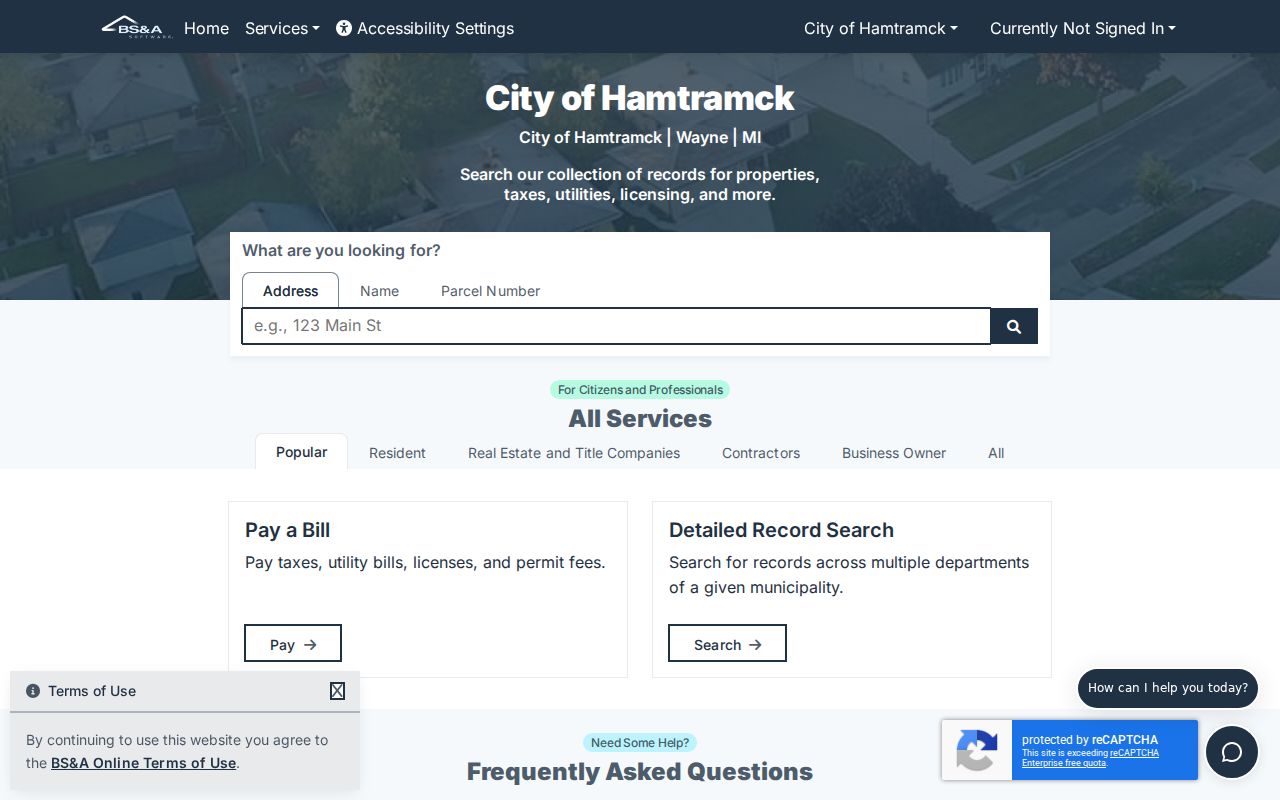
Use the result to capture the parcel and legal description before moving to the deed trail. The owner and mailing information should be treated as distinct from a statement about who occupies the address.
Hamtramck Voter Records and FOIA
Michigan’s Voter Information Center is the official individual status route. It can help with a registration, jurisdiction, or precinct question as the portal allows, but Michigan does not register voters by party and the tool is not a roster of every person on a street. Structured Qualified Voter File data is requested under Michigan FOIA. The request form offers geography such as state, county, city or township, district, ward, and precinct, rather than a general block search.
The voter file has firm field limits. Michigan describes registration records as public through FOIA while withholding driver or state ID data, month and day of birth, phone, email, digitized signature, the last four digits of a Social Security number, and similar protected items. A voter result can add a dated registration fact, not a full personal profile.
The Michigan Voter Information Center is the starting point for the individual lookup shown here.
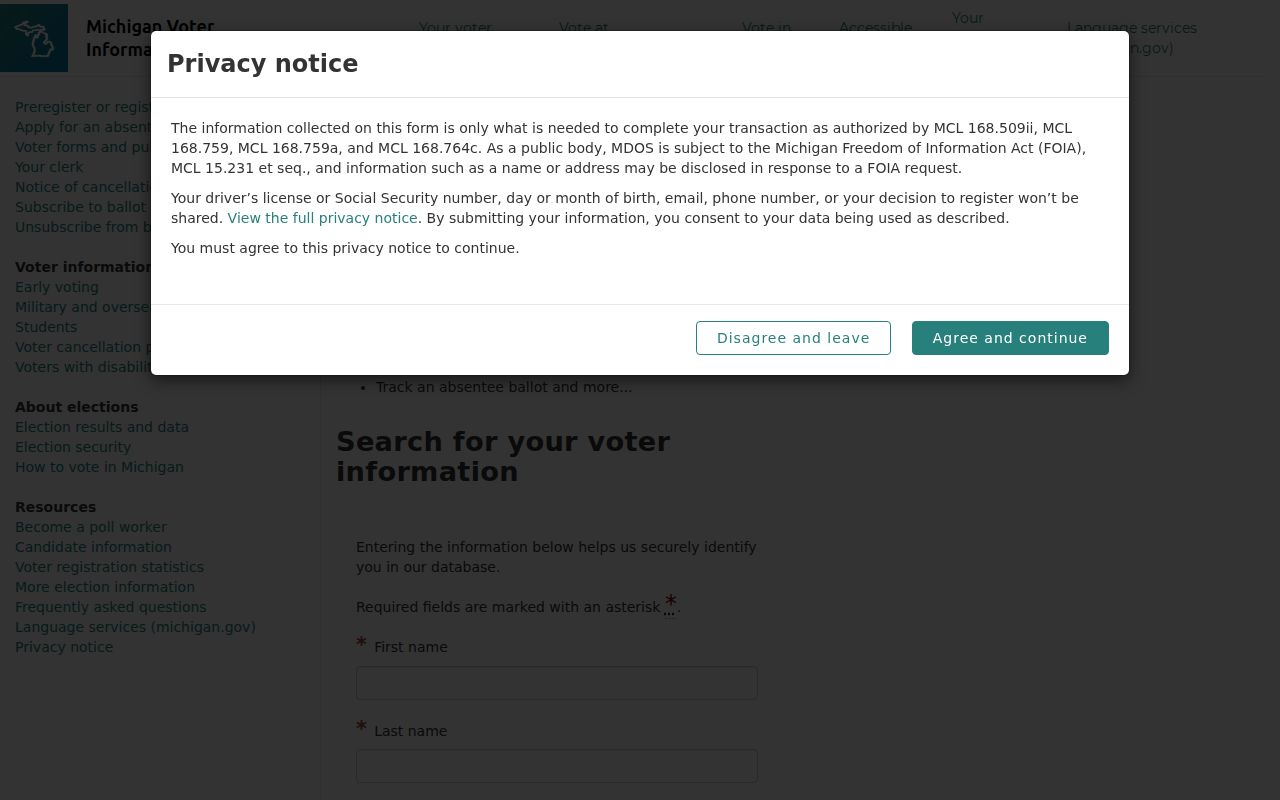
For a defined civic research question, use the state’s FOIA product instructions and request only the allowed geography and fields that answer it.
Hamtramck Deed Records After 1986
Wayne County describes the Register of Deeds as a land-record library with nearly 900,000 county parcels and history reaching to 1703 through liber and page references. Its web land-record search states post-1986 coverage. Start with a present parcel’s legal description, then search the current owner as grantee, locate the purchase deed, and search the seller as the earlier grantee. Match the lot, block, subdivision, and legal description instead of relying on a similar street number.
Online convenience has limits. The web service does not promise that every older county book is imaged. Older work can require the office, deed books, copies, or a staff-assisted search. The county says online accounts are time based, with $6 for 15 minutes or $24 for 60 minutes, while copies are $2 a page. In-person service has used appointments since October 1, 2025, so confirm the current notice before going to the counter.
- Parcel
- A tax and assessment identifier for a piece of property.
- Index
- A finding aid that points to a record; it is not automatically the full document image.
- Grantor and grantee
- The recorded transferor and recipient named in a deed.
- Criss-cross directory
- A reverse directory arranged from address to a listed name or household clue.
Hamtramck Court Record Limits
Courts answer a narrower question than a general residents directory. The 31st District Court at the municipal complex has a Court Innovations service for eligible traffic-ticket and past-due payment-plan requests. The form offers a name route and a driver-license or case-number route, with date of birth used in the driver-license path. It has a three-part sequence: search a case, submit a request, then await the court’s reply. It is not a complete Hamtramck name docket.
For county matters, Third Circuit public access can provide case search, registers of action, and civil judgments, but party-filed documents are not online and public results are not certified. Probate has its own court route. Michigan’s statewide MiCOURT service is also unofficial and excludes protected case categories. A missing web result may reflect a sealed, juvenile, expunged, or otherwise nonpublic matter.
The 31st District Court service presents the eligible traffic and past-due interface.
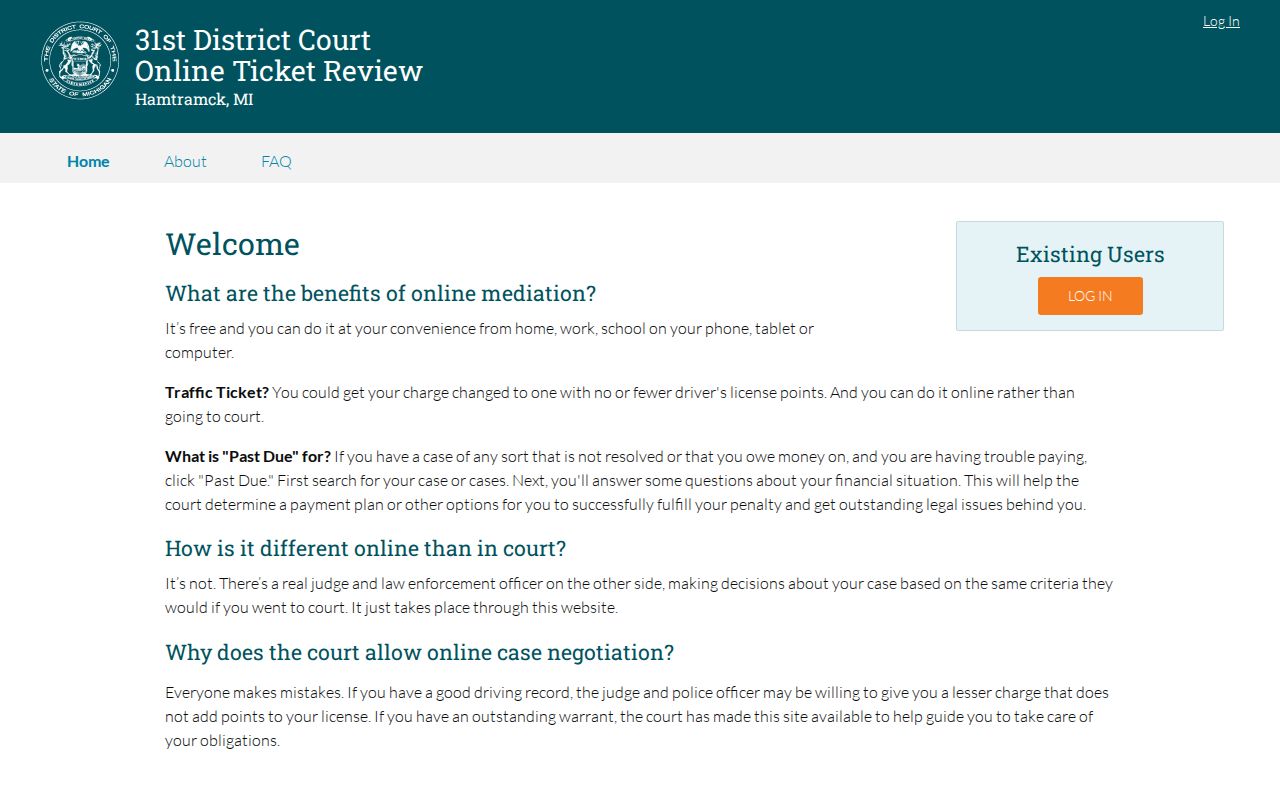
When a precise court record is needed, note the case number and ask the controlling court or Wayne County Clerk for the right register, file, or certified copy.
The Wayne Probate Court provides a separate electronic-docket route for estate and related case research.
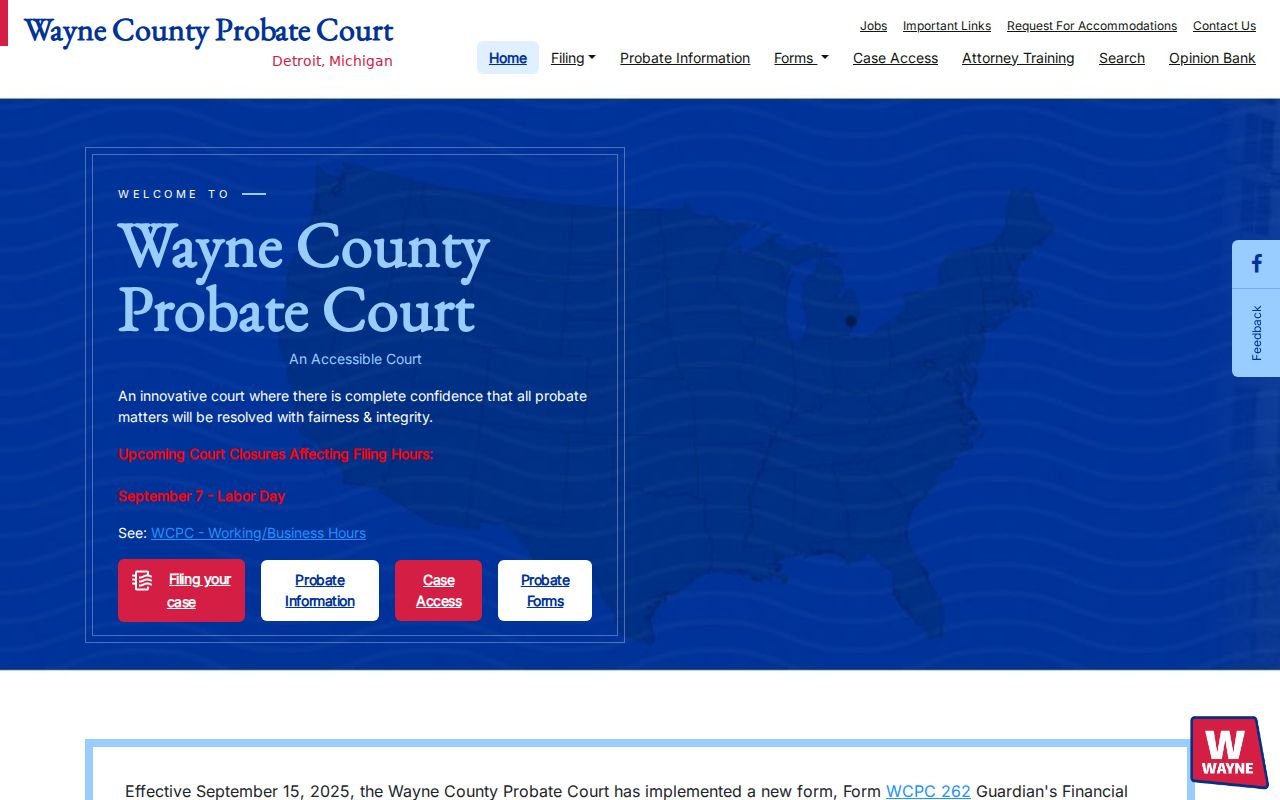
A probate caption can supply a research lead, but the petition, inventory, order, or certified file is the document to request when a specific fact must be verified.
Hamtramck Current Resident Sources
Current official sources each describe a separate relationship to an address. The comparison matters in Hamtramck because the city is compact, sits beside Detroit and Highland Park, and has postal overlap. A source that lists an owner, tax recipient, voter, or recorded party should be labeled by that role. For a name that needs independent confirmation, the Hamtramck resident lookup uses a one-person verification sequence.
| Hamtramck source | Record role | Custodian | Access route |
|---|---|---|---|
| BS&A assessment card | Owner, parcel, situs, tax and building context | City Assessor | Public web search |
| Michigan voter-status tool | Individual registration status as displayed | Michigan Department of State | Official lookup |
| Land-record index | Recorded grantor, grantee, and instrument trail | Wayne Register of Deeds | Post-1986 web search; office route for older work |
| Municipal records | City documents, election material, and licenses | Hamtramck City Clerk | City page and Michigan FOIA |
Official sources identify a custodian, date, and record purpose. Unverified web listings may be stale or combine people with the same name, so they should not replace a record-by-record check.
| Official record path | Unverified online listing category |
|---|---|
| Shows its keeper, stated access rules, and a way to request correction or certification. | May not show update dates, source roles, or a way to resolve a same-name error. |
| Can be checked against a parcel, docket, application, or archival item. | Should be treated as a lead that needs independent confirmation. |
Hamtramck Vital Record Routes
Birth, death, marriage, and divorce records do not share one access rule. Michigan MDHHS issues state-certified products for events from 1867 onward, while Wayne County and the courts have separate county routes. Birth records under 100 years are restricted by eligibility. Records over 100 years are public under MCL 333.2882, while the separate full-record genealogy release rule is 110 years under MCL 333.2885. Michigan death genealogy access has a 75-year rule. A historical index can identify an event without granting access to a certified record.
Michigan allows death and marriage requests with the stated fee and written-request process, and divorce certificates have their own product rules. MDHHS lists mail, authorized online or phone ordering, dropbox, and appointment channels. Wayne County also has a marriage application route. Keep a court file distinct from a certificate: the two sources can contain different information and have different copy procedures.
The MDHHS order page explains the state product and submission channels.
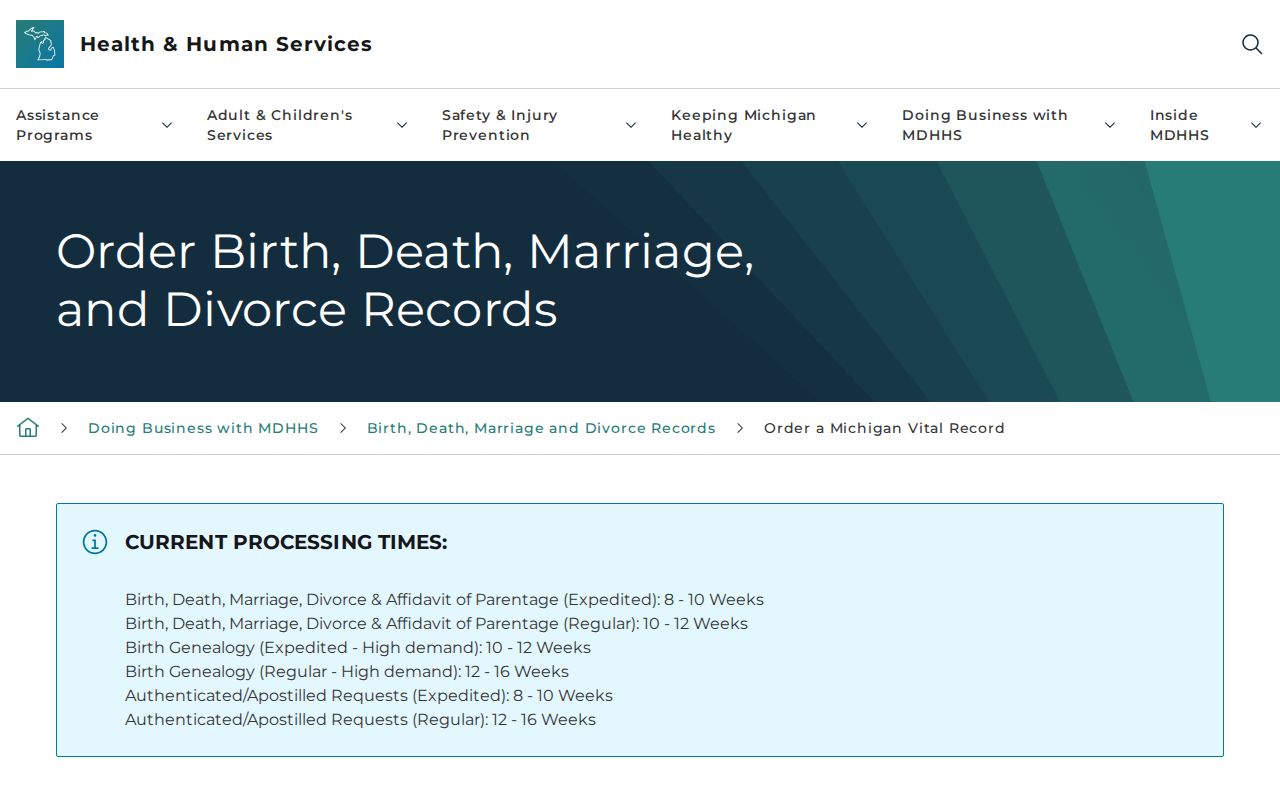
Use the product’s current eligibility and fee instructions before submitting a request, especially when a historical finding is being used to seek a certified copy.
Hamtramck Resident Record Myths
A postal city label, an assessor mailing address, a deed grantee, a voter registration, and a directory occupant do not answer the same question. The assessor situs field locates a parcel, while a tax mailing field says where notices are sent. A deed names legal parties to a transfer. A directory records who was listed when the volume was compiled. In Hamtramck, where municipal borders and postal labels can change quickly, keeping those roles separate is more useful than trying to make a single line stand for every connection.
The City Clerk is the right channel when the needed item is a municipal record not posted online. Michigan FOIA requests should identify the document, date range, department, meeting, address, or record series as narrowly as possible. The Attorney General’s guidance describes a five-business-day response, or a written extension of up to ten additional business days. Agencies may redact protected material and give an itemized lawful fee estimate.
The Hamtramck City Clerk page links its FOIA form, procedures, policy, and cost information.
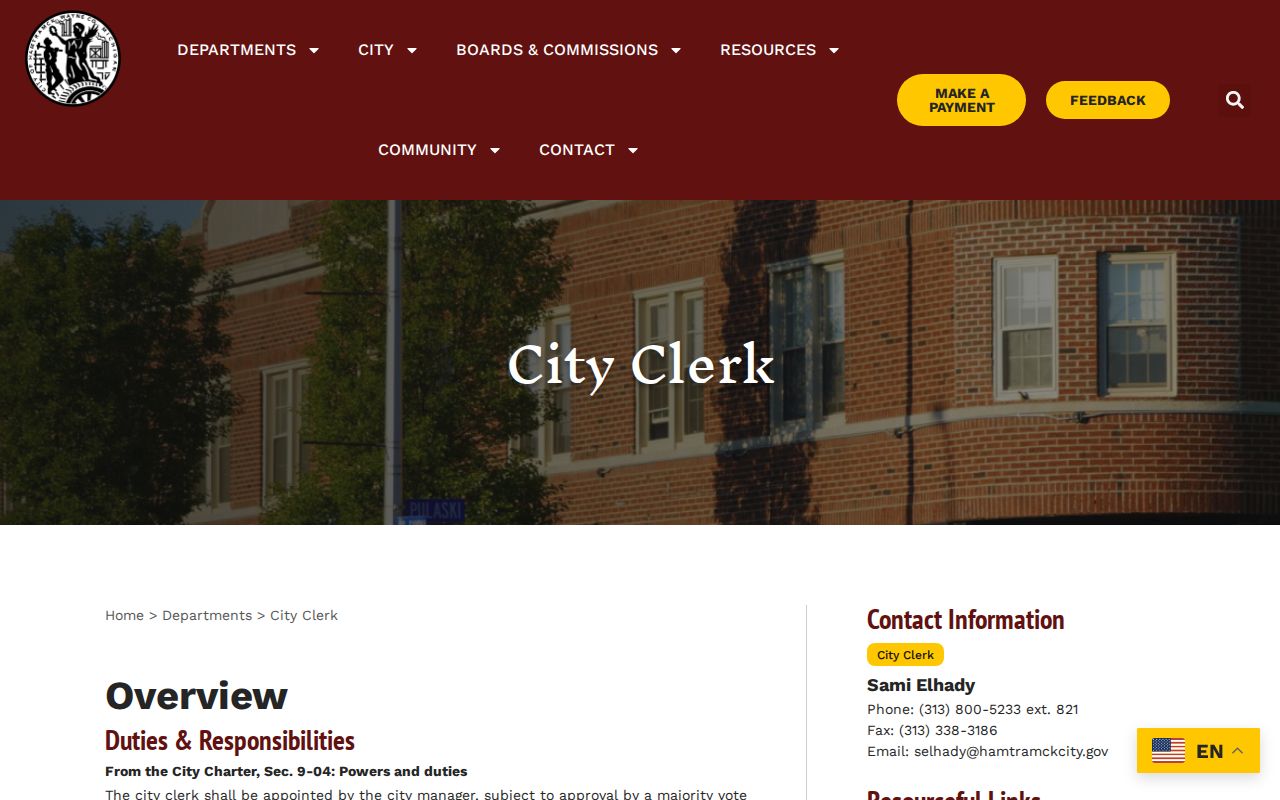
A focused request is easier for a custodian to identify and makes the response or redaction decision easier to evaluate.
Hamtramck Historical Resident Directories
Historical work needs a shelf as well as a search box. Verified leads identify Hamtramck directory entries for 1918, 1934–35, 1954, and 1957, but a complete local run and final printed year were not published in an official catalog. The Detroit Public Library’s Burton Historical Collection is the documented regional backstop for directories, newspapers, maps, family histories, church material, obituaries, land records, and local-history books. Its Detroit directory runs begin in 1837 and include long selected series, but a Detroit entry should not be assumed to be a Hamtramck entry.
Reverse or criss-cross volumes work from an address to a listed person; alphabetical volumes work in the opposite direction. Pair a directory year with the nearest public census schedule and preserve the publication date. Census enumeration, directory compilation, and a household move may not happen at the same time. Burton’s Merique scrapbook index can also bridge people, churches, events, weddings, anniversaries, and Hamtramck Citizen references; the documented copy service is $15 for up to three articles with a stated one-to-two-week window.
Hamtramck’s Historical Commission is another local-history route. Its ordinance authorizes it to collect, catalog, preserve, classify, index, and make available materials about early residents, including maps, papers, archives, and oral histories. The research did not locate a public catalog or fee schedule, so ask the city about a specific inactive record or historical topic instead of assuming the collection is searchable online.
Note: A historical directory is a dated listing, so confirm its jurisdiction, abbreviation key, page or image, and source year before relying on it.
Hamtramck Boundaries Change Searches
Hamtramck is an independent city of roughly 2.1 square miles, bordered largely by Detroit with a small Highland Park edge. I-75 lies to the west and I-94 to the south. That setting makes a city label, county record, parcel polygon, and ZIP code separate facts. The verified Hamtramck-associated ZCTA is 48212. A USPS grouping also references 48214 with Hamtramck post-office context, but that is not proof that 48214 lies inside the city. USPS warns that ZIP codes do not necessarily follow municipal boundaries.
Older documents create another layer. Hamtramck was a township in 1798, a village in 1901, and a city in 1922. Master Plan maps use 1860, 1893, 1904/1920, and 1937 eras. A regional directory may expose original and post-1921 Detroit house-number fields, yet no Hamtramck-specific adoption of that renumbering was verified. Retain the original place wording, then use the assessor and GIS boundary layer to test a modern parcel.
Hamtramck Privacy and Fraud Safeguards
Public access has limits. Michigan’s Address Confidentiality Program provides eligible people at risk with a designated address and mail forwarding. Actual residences, protected voter fields, sealed court material, and other confidential details do not become public directory material simply because a related record exists. Michigan stalking law, MCL 750.411h, also makes repeated harassment and unwanted contact a serious legal concern. Use records for lawful personal research, family history, estate questions, civic transparency, or safety verification, never to track or pressure someone.
Lawful use. A Hamtramck residents search should preserve source limits and privacy protections; do not use an address or record to stalk, harass, intimidate, or harm anyone.
Wayne County’s Fraud Guard is a practical property-record safeguard. The official process uses a monitored name, two confirmation emails, and an alert if a document is recorded under that name. A suspicious recorded-document notice should be checked with the Register of Deeds rather than a solicitation. The county provides a complaint route at (313) 224-5869.
The Wayne Register of Deeds notice provides Fraud Guard and current office information.
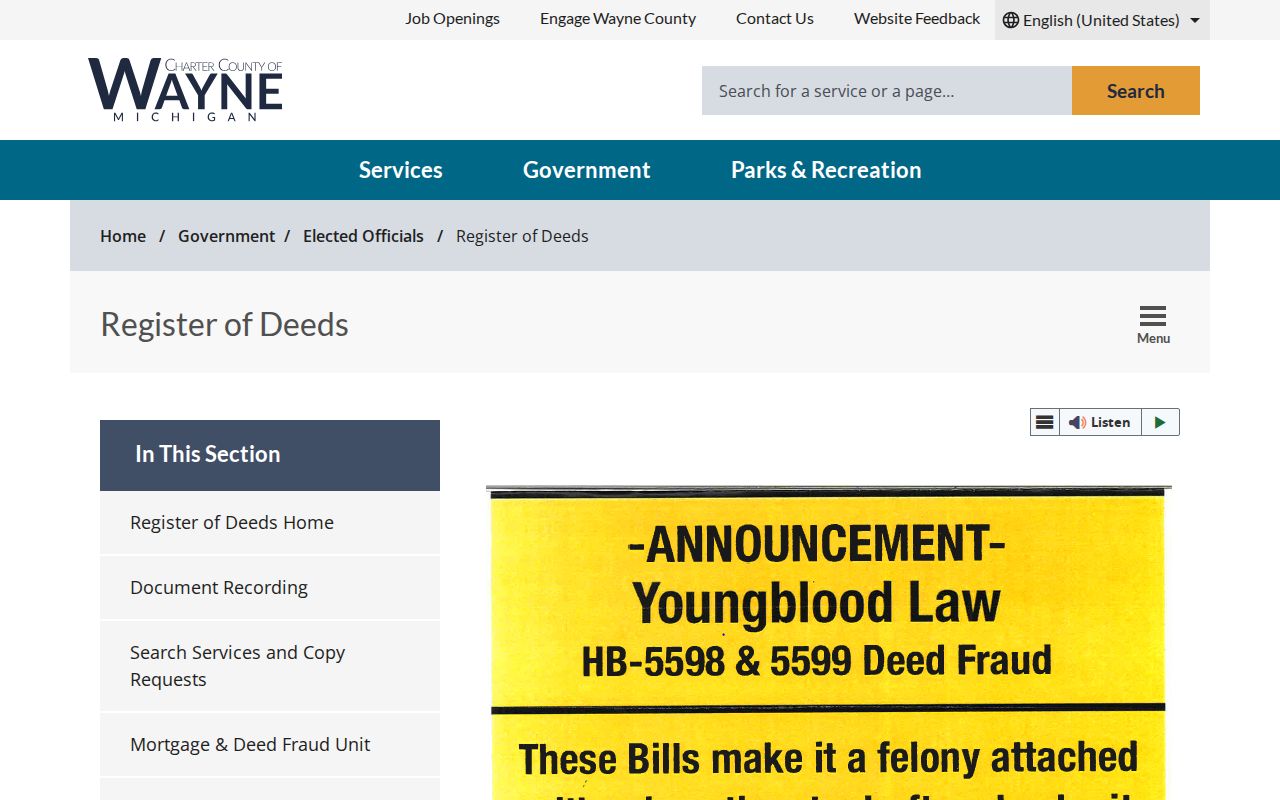
Fraud Guard can flag a recorded-name event, while the land-record index and office staff remain the place to verify the actual instrument.