
Hamtramck City Directory Collections
Documented Hamtramck city directory leads are scattered rather than held as one confirmed, continuous run. The established genealogy guide identifies 1918, 1934-35, 1954, and 1957 entries, with sources associated with MyHeritage and the Allen County Public Library. That is a useful starting shelf, not proof that every page is open or that no other year survives. The nearby Burton Historical Collection adds long Detroit runs and regional material, while Detroit Public Library digital collections can supply item-level images. Keep Hamtramck, Detroit, and metropolitan labels separate when searching.
| Collection | Years | Where Held | Access |
|---|---|---|---|
| Hamtramck city directory leads | 1918; 1934-35; 1954; 1957 | LDS Genealogy Wayne directory guide identifies MyHeritage and Allen County sources | Search by name or address, then verify scan availability with a library |
| Detroit city directories | 1837; 1845-46; 1850-1941; selected 1953-1974 years | Burton Historical Collection | Alphabetical and address research; check whether Hamtramck is listed separately |
| 1907 Yiddish Directory Database | 1907 | Jewish Historical Society of Michigan | Searchable interface and page images; Detroit Jewish directory, not a Hamtramck municipal run |
| Digitized local-history material | Variable | Detroit Public Library Digital Collections | Search by collection or item; available image fields vary |
The missing pieces matter. No official local catalog supplied a complete Hamtramck directory sequence, a last printed year, or a complete publisher list. A volume found through a guide should be cited by its own year, publisher or repository, and page or image number. Do not turn a gap in an online catalog into a claim that a year was never printed.
Hamtramck Directory Years We Can Verify
The verified Hamtramck leads fall across a period when the city’s boundaries and population story were changing quickly. Hamtramck Township began in 1798, the village formed in 1901, and the city incorporated in 1922. Dodge broke ground in 1910 and began operations in 1914. Those dates help explain why a family may appear under a township, village, city, Detroit, or industrial-era description, even when later accounts use a single modern place name.
A city directory is only one annual publishing event. It can list an address that differs from an enumeration date or from the day a family moved. Detroit directories at Burton are a regional backstop, but they are not automatically a Hamtramck-only list. Search the name, street, and nearby Detroit entries, then note the jurisdiction printed in the source. This approach preserves the source’s own geography instead of rewriting it.
The Jewish Historical Society of Michigan directory database shows why a digitized directory needs careful reading before its details are carried into a Hamtramck search.
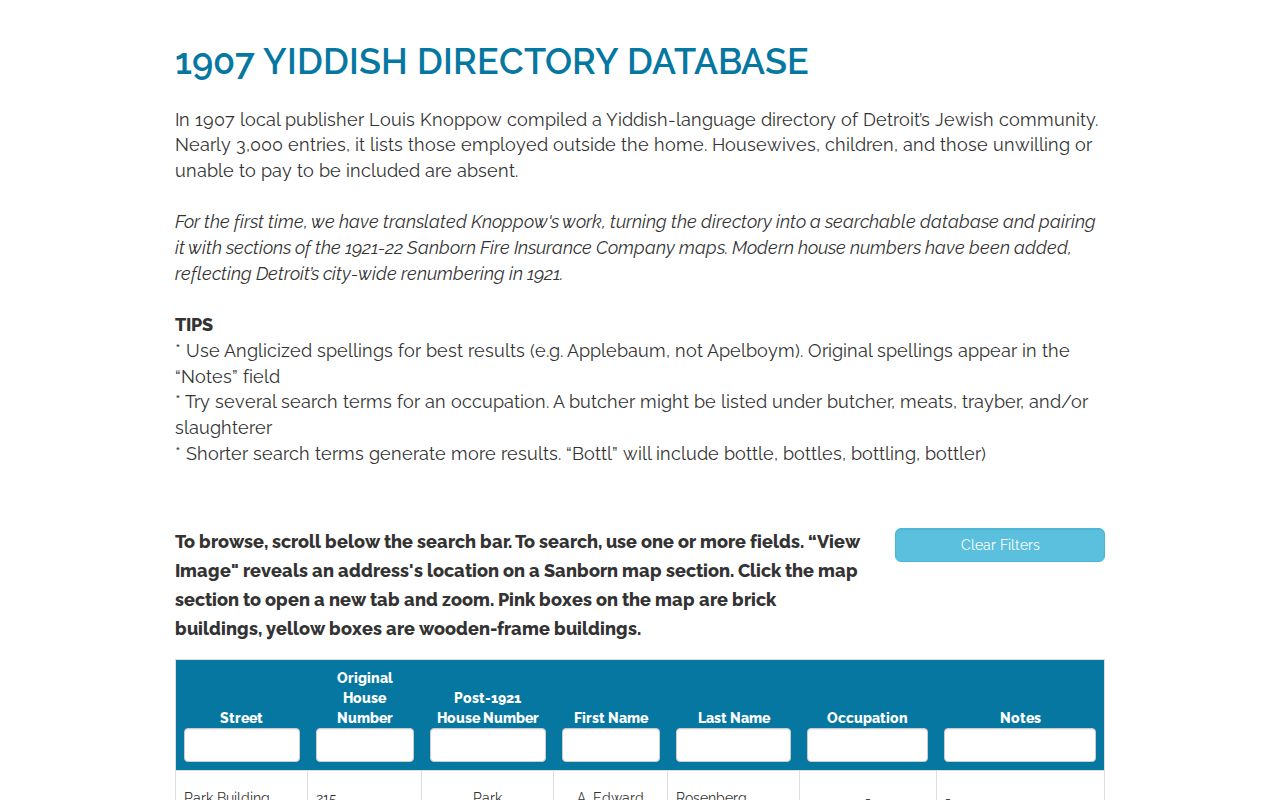
Its visible fields include street, original house number, post-1921 house number, first and last name, occupation, notes, and a page-image control. It is an instructive Detroit example, not evidence of a Hamtramck municipal directory run.
Note: Record the publication year and the place label before combining any directory result with a census or deed.
Reading Hamtramck City Directory Entries
Once a volume is open, copy what it prints before drawing conclusions. A typical entry can supply a surname and given name, spouse or widow notation, occupation, business detail, street address, telephone, and an ownership notation if the publisher used one. The abbreviation key controls the meaning of short marks. It may be near the front or back of the volume, so capture it with the entry rather than expanding a letter from memory.
| Name | Record the spelling, initials, married or widow notation, and every printed variation. |
|---|---|
| Occupation or business | Copy the concise role or business wording as printed, including abbreviations. |
| Street address | Keep the house number and street spelling together with the directory year. |
| Ownership notation | Some volumes use a mark for an ownership detail; read it only through that volume’s key. |
| Image reference | Save the page or image link when one exists, so the entry can be checked later. |
- Criss-cross directory
- An address-ordered section that turns a street and house number into a possible resident or business clue.
- Householder index
- An alphabetical name section used to move from a person’s name to the address printed for that year.
- Abbreviation key
- The publisher’s explanation of the short forms used in its entries. It is the only safe basis for expanding a mark.
A searchable record should still be read as a page. The JHSM sample can show institution or person name, number fields, occupation, notes, and a scanned image, but the research did not locate a confirmed Hamtramck scan showing every printed abbreviation. Leave an unclear mark unresolved instead of inventing its meaning.
Hamtramck Directory Number Changes
Original and post-1921 house-number fields in the JHSM interface are a valuable regional warning. The database explicitly separates them, and its search guidance notes that Anglicized spellings and shorter occupation terms can improve a search. That does not prove that Hamtramck itself adopted the same numbering change. It does show why an old address should be tested as printed before a modern number is assumed to be equivalent.
Names also deserve more than one pass. Hamtramck’s Polish, Ukrainian, Arab, Muslim, and other migration histories can produce original-language, Anglicized, married, maiden, or transliterated forms. Search each form separately and do not combine two entries only because a surname looks similar. A street, spouse notation, business name, or census relationship can provide the independent check.
Record check. A directory occupant, postal label, deed grantee, voter result, and tax-mailing address answer different questions. Treat a directory line as a dated occupancy clue, not proof of every other relationship.
For modern parcel research, the Hamtramck by-street directory uses address-keyed county and city records rather than rebuilding a historical directory entry as a current record.
Trace a Hamtramck Directory Household
Household tracing works best as a controlled sequence. Start with the street spelling and exact address in an address-ordered or reverse volume. Where the source offers both number systems, test both. Then read the alphabetical entry for the likely person and write down each printed name form, spouse or widow notation, business detail, street, and directory year. A line that disappears may reflect a move, death, omission, or a changed spelling, so it needs another source before it becomes a conclusion.
- Locate the address or name in the earliest available Hamtramck directory lead and save the page or image reference.
- Read the alphabetical entry and the abbreviation key, then record spelling, spouse notation, business, street, and year exactly as printed.
- Compare the next available directory year. Separate a changed address from a changed person until another record ties them together.
- Pair the result with the 1910, 1920, 1930, 1940, or 1950 public census schedule nearest the directory date.
- Use the county deed chain for recorded transfers and obituary, church, cemetery, probate, or newspaper material to test moves, deaths, and heirs.
Census dates, directory publication dates, and move dates are not identical. A deed’s grantee is a recorded legal party, while a directory entry is an annual publication snapshot. Keep those roles separate. The same caution applies to an ownership notation inside a volume: it does not replace a recorded transfer.
Field tip. Burton’s Kenneth Merique scrapbook index can bridge a name to churches, events, birthdays, weddings, anniversaries, and Hamtramck Citizen references when the newspaper page is not online. Its copy service is listed at $15 by check or money order for up to three articles, with a stated one-to-two-week window.
Hamtramck Directory Research at Burton
The Detroit Public Library’s Burton Historical Collection is the best documented nearby research shelf for Hamtramck names. Its holdings include books, manuscripts, maps, newspapers, photographs, family histories, churches, military material, obituaries, land records, and regional local history. Burton also has early Wayne births and marriages, death-index runs, cemetery material, naturalization records, early land transfers, probate material, and telephone books for other towns. These related sources can test a directory entry without pretending that any one source is complete.
Burton Historical Collection information gives the collection’s research route and current contact details.
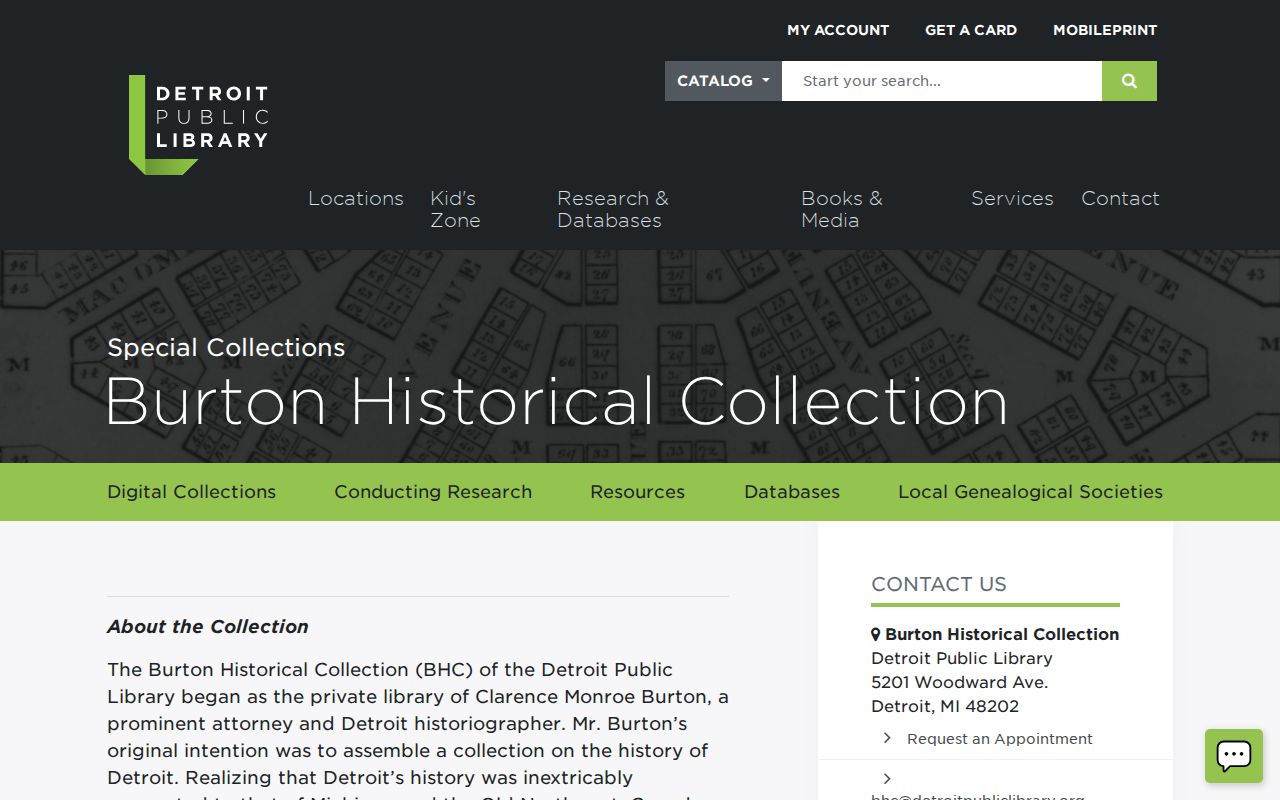
Burton is at 5201 Woodward Avenue in Detroit, with contact at (313) 481-1401 and bhc@detroitpubliclibrary.org. Posted hours include Tuesday through Saturday research hours and appointment windows, plus October through May Sunday hours, so verify before travel.
Ancestry Library Edition is onsite-only there. Detroit Free Press coverage from 1831 through 1999 uses a library-card route, and Digital Sanborn Maps from 1867 through 1970 are onsite. Each access rule belongs to the service named, not to every Burton record.
Hamtramck Directories Beyond Print
The Hamtramck Public Library database page is the first local call for a local-history shelf, newspaper microfilm, clippings, yearbooks, oral histories, funeral notices, and any city-directory or reverse-directory runs. It links local organizations and the Hamtramck Review, but the research did not find published directory-year or obituary-run details. Ask about a specific surname, street, and year range instead of assuming the shelves contain a complete series.
The Hamtramck Historical Commission may hold another route. Its authority includes collecting oral histories and reproductions of inactive city records, yet no public catalog or request fee was located. That gap is not evidence that the collection is empty. Contact the commission for holdings and access, and cite any response as a repository lead until the underlying record is inspected.
Hamtramck Historical Commission information describes the city body responsible for preserving and sharing local history.
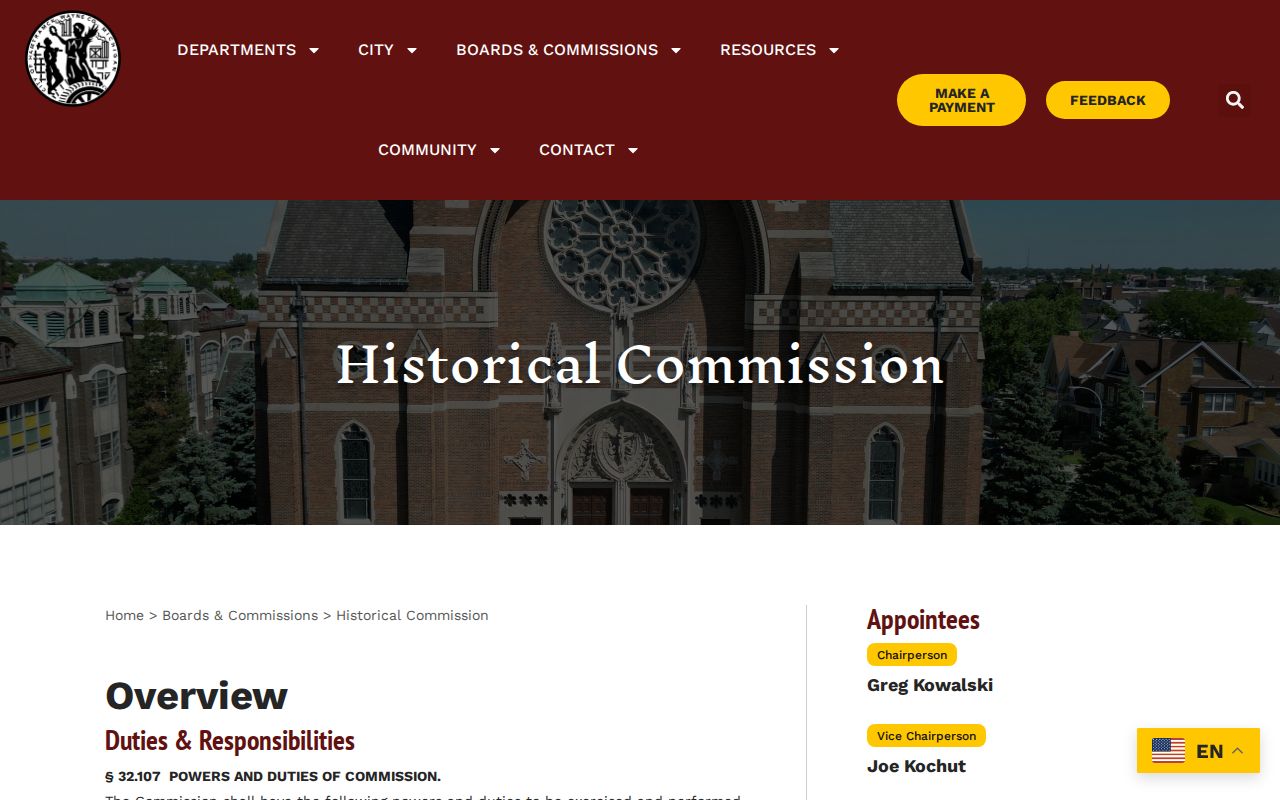
The commission image is a source lead for inactive municipal records and oral histories, not a searchable directory catalog. Preserve that boundary when a family story is paired with a printed listing.
Hamtramck Directory Clues in Archives
Archives and newspapers can close a gap left by the directories. The Archives of Michigan Wayne County guide lists probate calendars from 1797 to 1914, estate files from 1797 to 1901, later estate groups, probate registers, and selected tax and vital material. Burton’s regional holdings add cemetery and obituary leads. A probate caption can identify a decedent or fiduciary, but the relevant petition, inventory, account, or order must be requested for the detail it actually contains.
Church and organization records can also help with a Hamtramck name, especially where newspapers, parish histories, or community archives supply context. No unified public online Hamtramck church-register index was located. Search a named archive or collection for baptism, marriage, burial, anniversary, and parish-history material, and do not assume a private membership ledger is open.
The collection trail changes with time. Modern online record access, Burton’s paper and microfilm shelves, and archive probate groups serve different eras. That difference is useful: a directory entry can provide the name and street to carry into the right repository, without claiming that every historical fact is online.
Note: Save the repository, year, page or image, and abbreviation key with every directory finding so another researcher can repeat the check.